upgrade your garage door today

Warning Signs You Should Know About Unlicensed Garage Door Companies

Unlicensed garage door companies rely on fabricated licenses, fake insurance certificates, and stolen branding to appear legitimate before any work begins. These fake credentials are designed to survive a quick glance, not close inspection, which is exactly why so many property owners get fooled during a garage door repair call.

A property owner who knows what these fabricated documents and specific details actually look like can spot the problem before a technician ever steps into the garage. The sections below break down the specific credentials scammers fake most often and exactly how each one is meant to deceive.
Key Takeaways

  • Fake business names and logos are copied directly from real, established companies.
  • Phony addresses and P.O. boxes are used to appear locally based.
  • Vague licensing claims rarely hold up when a real number is requested.
  • Insurance certificates are often fabricated or copied from unrelated businesses.
  • Fake company IDs and badges are printed to mimic legitimate employee credentials.

Common Fake Credentials and Tactics

Common Fake Credentials and Tactics

Impersonation and Name Piggybacking

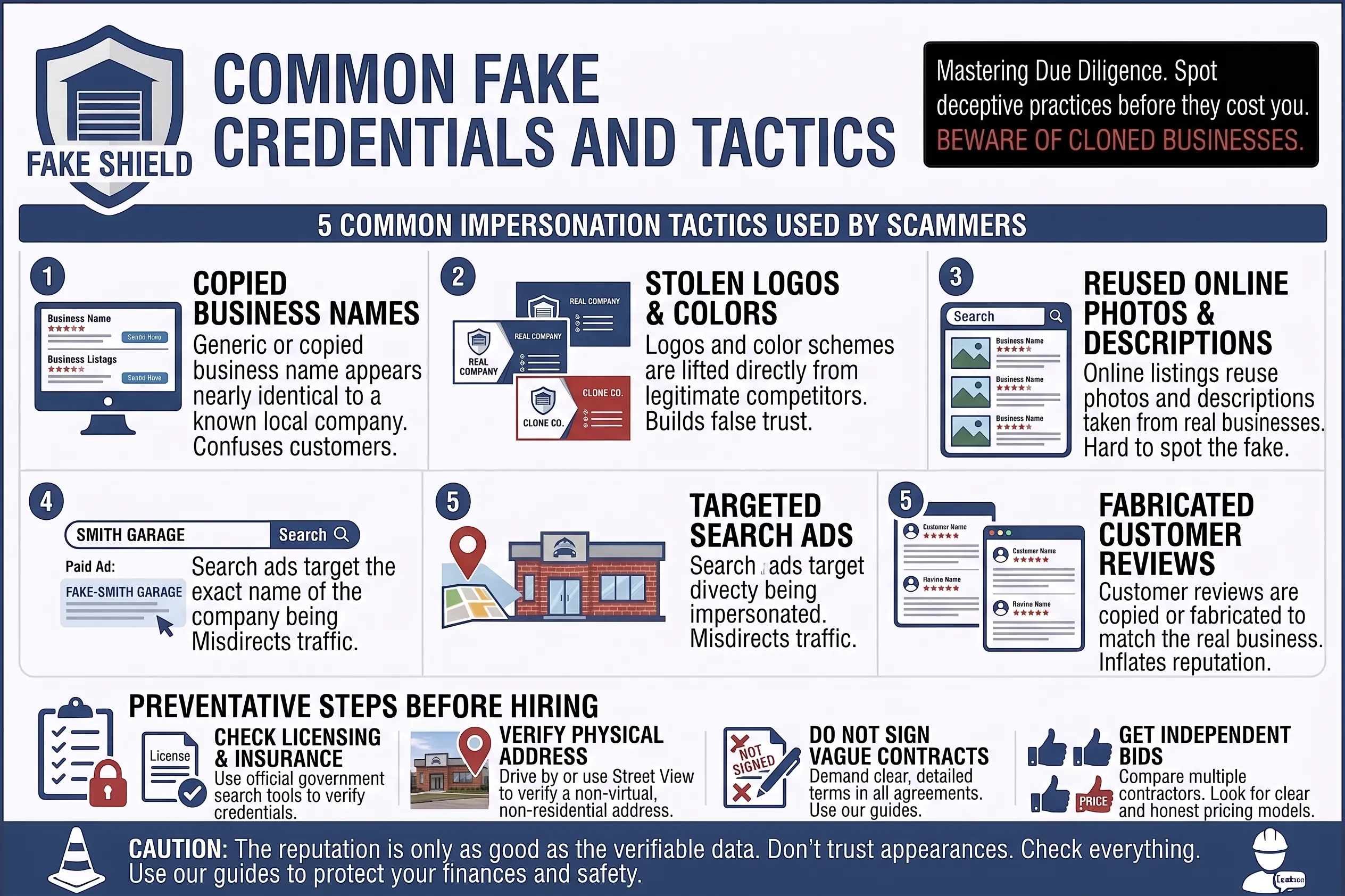
Scammers frequently steal the exact name, logo, and branding details of a real, established garage door company to trick both search engines and customers.

This tactic tends to follow a consistent pattern:

  • A generic or copied business name appears nearly identical to a known local company.
  • Logos and color schemes are lifted directly from legitimate competitors.
  • Online listings reuse photos and descriptions taken from real businesses.
  • Search ads target the exact name of the company being impersonated.
  • Customer reviews are copied or fabricated to match the real business.

To understand what happens once one of these impersonated companies gets hired, read our guide on What Happens When Hiring an Unlicensed Garage Door Company?, which breaks down the financial, safety, and legal risks that follow.

Fake Local Addresses

A phony street address, virtual office, or P.O. box is often listed to create the appearance of a nearby, established business operating out of the area.

These fake addresses tend to share a few common traits:

  • The listed address belongs to a mailbox service or virtual office provider.
  • No legitimate physical location exists at the address given.
  • Google Maps or satellite view shows a residence, empty lot, or unrelated business.
  • Dispatch actually originates from a call center outside the region entirely.
  • The address changes across different listings for the same business name.

Shifting or unverifiable addresses across multiple online listings are often the fastest, most reliable way to confirm a business is not truly local. 

Vague or Missing Licenses

A company may claim to be licensed and insured over the phone or in a paid search ad, yet fail to produce a real, verifiable license number once asked directly.

This gap between the claim and the paperwork tends to show up clearly:

  • The technician cannot recite a license number without checking notes or hesitating.
  • The number provided does not match any record in the state database.
  • Written proof of licensing is never brought to the appointment for any type of garage door service.
  • The company deflects the question by emphasizing years of experience instead.
  • Licensing claims change slightly between the phone call and the in-person visit.

To confirm whether a license number is real before any repair begins, read our guide on How to Verify a Garage Door Company Is Licensed, which covers the exact steps for checking a license against the state database.

Fabricated Insurance Certificates

Insurance certificates presented on site are sometimes copied, altered, or invented entirely, leaving the property owner with no real liability protection during the job.

These fabricated documents tend to reveal themselves through the following signs:

  • The certificate lists a policy number that cannot be verified with the insurer.
  • The insured business name does not match the company performing garage door installation or repair work.
  • Coverage dates on the certificate have already expired or have not started.
  • The document format looks generic or inconsistent with standard insurance paperwork.
  • A direct call to the listed insurer cannot confirm the policy exists.

To find out which protections are lost once fake insurance paperwork is involved, read our guide on What Warranty Protection Is Lost With an Unlicensed Repair?, which breaks down how missing coverage affects manufacturer warranty terms. 

Fake Company IDs or Employee Badges

Printed identification badges are sometimes produced specifically to mimic the appearance of a legitimate company employee credential.

A few details tend to expose these fabricated badges:

  • The badge photo does not match standard employee ID formatting or quality.
  • No verifiable employee number or company directory listing exists.
  • The badge lacks security features found on real contractor identification, unlike a genuine garage door replacement technician.
  • Lamination or printing quality looks noticeably inconsistent or homemade.
  • The technician cannot answer basic questions about the company shown on the badge.

Businesses using fabricated identification can be reported directly to help prevent the same tactic from working on another property owner.

How Real Credentials Differ From Fake Ones

Knowing exactly where to look and what to check turns a vague feeling of doubt into a confirmed answer within minutes.

Credential Type

How to Verify a Real One

Common Sign of a Fake One

License Number

Search the Michigan LARA database directly

Number does not match any record on file

Insurance Certificate

Call the listed insurer to confirm active coverage

Coverage dates are expired or cannot be confirmed

Business Address

Confirm a physical location through mapping tools

Address is a P.O. box or virtual office

Employee ID

Ask the company office to confirm the employee number

No employee record exists for the name shown

Branding

Compare the business name against state registration

Name closely mimics a known local company

Verifying even one of these details directly with the source, rather than trusting what is shown on site, exposes most fabricated credentials immediately.

A Direct Verification Check Exposes Fake Credentials Immediately

A Direct Verification Check Exposes Fake Credentials Immediately

A company relying on stolen branding, fake addresses, or fabricated licenses depends entirely on property owners not asking the right questions before hiring. Any fake license, certificate, or badge can be confirmed or disproven within minutes using a state database, a phone call, or a direct request for documentation.

Brothers Garage Door Service provides licensed, verifiable credentials on every job completed for residents across Livonia who want proof before any technician starts work. Contact us or give us a call today, and let our licensed team show the documentation that unlicensed companies cannot produce.

Frequently Asked Questions

How can a fake garage door company license be identified?

A fake license number will not match any record in the state licensing database when checked directly. Requesting the number before scheduling and verifying it independently exposes most fabricated licenses immediately.

Copying an established company’s branding creates instant trust and helps the business appear in local search results without earning that reputation. This tactic relies on property owners not noticing small differences in the name or details.

A fabricated certificate often lists a policy number that cannot be verified with the actual insurer or shows coverage dates that have already expired. Calling the listed insurance provider directly confirms whether the policy is real.

A legitimate garage door company typically has a real, physical location that can be visited or verified through mapping tools. A P.O. box or virtual office listed as the only address is a common sign of an unlicensed operation.

Fake badges are often printed with copied logos and generic formatting that lacks the security features found on real contractor identification. Inconsistent lamination, printing quality, or missing employee details usually give these badges away.

A verbal claim of being licensed and insured means nothing without a real, verifiable number attached to it. Confirming that number against the state database before the appointment removes any guesswork.

Service should be declined immediately if a company hesitates or cannot provide a verifiable license number on request. Continuing with an unlicensed technician removes any legal or financial protection during the job.

Licensed companies typically operate vehicles with visible company branding, logos, and contact information. A technician arriving in an unmarked or rental vehicle is a common warning sign worth investigating further.

A quick search using mapping tools usually confirms within minutes whether an address belongs to a real business location or a mailbox service. This step takes far less time than dealing with the aftermath of an unlicensed repair.

Presenting fabricated licenses, insurance documents, or identification to secure work is fraudulent and can carry legal consequences beyond a simple licensing violation. Reporting the business to local authorities or the Better Business Bureau helps document the pattern for other property owners.

Book Online!