
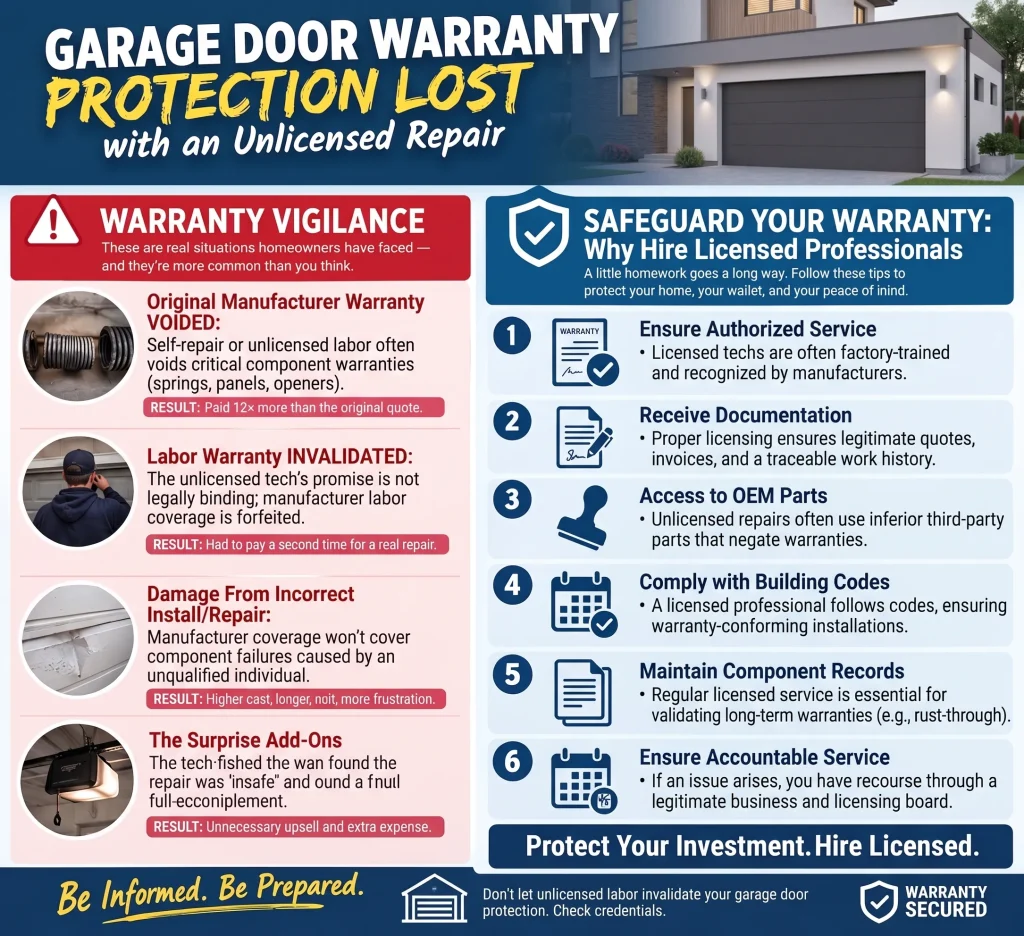
An unlicensed repair can void manufacturer coverage on the door, opener, and any garage door spring or component involved in the job. Warranty terms almost always require certified installation, and uncertified work strips that protection immediately, regardless of how the repair actually performs.
Property owners rarely learn about this loss until a later issue surfaces unexpectedly, and the manufacturer denies the claim entirely without warning. The sections below break down exactly which warranties disappear, why the loss happens, and what steps help preserve coverage on future repairs.
Key Takeaways
- Manufacturer coverage on the door itself is voided by uncertified installation.
- Opener and motor warranties require certified setup to remain valid.
- Damage to one part can void coverage on connected systems as well.
- Some warranty agreements are voided entirely once unlicensed work occurs.
- Keeping proof of licensed service preserves coverage for future repairs.
Warranty Protection Lost With an Unlicensed Repair
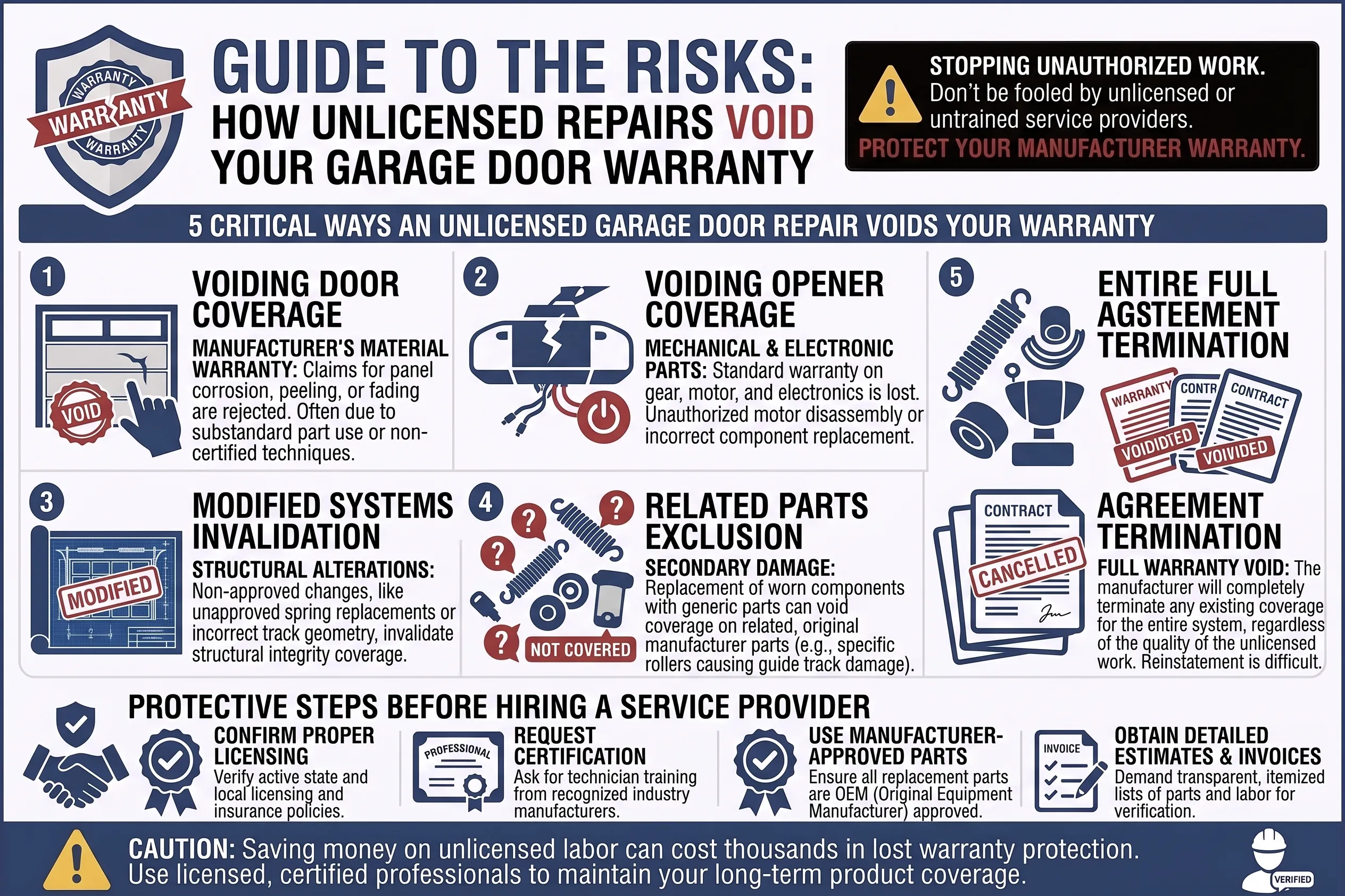
Manufacturer warranties are built around certified installation standards, and unlicensed work almost always falls outside those requirements.
Coverage Type | What It Normally Covers | Why It Gets Voided |
Door Coverage | Panels, sections, and structural defects | Installation does not follow certified methods |
Opener Coverage | Motor, circuit board, and drive components | Setup skips manufacturer wiring and calibration standards |
Modified Systems | Any part altered during the repair | Alteration itself breaks warranty terms |
Related Parts | Connected components tied to the repaired part | Secondary failure traces back to the original unlicensed work |
Full Agreement | The complete manufacturer warranty | Licensed service was a condition of the agreement itself |
Manufacturer Coverage on the Door
Door warranties typically cover panel defects, structural issues, and material failures, but only when installation follows the manufacturer-approved process.
Coverage on the door itself depends on the following conditions:
- Installation steps match the exact sequence the manufacturer specifies.
- Only approved parts and hardware are used during the repair.
- No structural modifications are made outside of standard procedure.
- Proof of licensed installation exists if a claim is filed later.
- The door model and serial number remain properly registered.
To understand how a company without proper credentials affects this coverage, read our guide on What Fake Credentials Do Unlicensed Garage Door Companies Use?, which breaks down the documentation scammers fake to avoid this issue.
Opener and Motor Coverage
Garage door opener warranties depend heavily on correct wiring, calibration, and mounting, all of which require training most unlicensed technicians lack.
Coverage on the opener and motor depends on the following conditions:
- Wiring is completed according to the manufacturer’s electrical specifications.
- Force and travel limits are calibrated within the approved range.
- Mounting hardware matches what the manufacturer specifies for the model.
- Safety sensors are installed and aligned to factory standards.
- Software or smart features are registered under the correct account.
Missing even a single calibration step during initial setup is often enough to void coverage for the entire opener and motor system.
Coverage for Modified Systems
Any part altered, adjusted, or replaced during an unlicensed repair typically loses its own warranty protection immediately, regardless of the rest of the system.
Modifications tend to affect coverage in the following ways:
- Replacing a broken garage door spring with a non-approved part voids coverage on that component.
- Adjusting factory tension settings removes protection on the spring system.
- Rewiring the opener circuit voids coverage on the electrical components.
- Altering track alignment voids coverage on the track and roller system.
- Installing aftermarket accessories can void coverage on connected parts.
To learn how modifications like these tie into the broader risks of hiring the wrong company, read our guide on What Happens When Hiring an Unlicensed Garage Door Company?, which breaks down the financial and safety consequences involved.
Future Claims on Related Parts
A single unlicensed repair can cause a secondary failure in a connected system, and that resulting damage is typically excluded from coverage.
This spreading effect tends to follow a predictable pattern:
- Improper wiring during an opener repair can damage the circuit board later.
- A misaligned track can cause premature wear on rollers and cables.
- Incorrect spring tension can strain the opener motor over time.
- Damage traced back to a business with no verifiable service history voids the related claim.
- Manufacturers often deny claims tied to any part touched during the repair.
One overlooked repair step can quietly disqualify coverage on parts that were never even touched during the original visit.
Loss of the Entire Warranty Agreement
Some manufacturer agreements require licensed service as a condition of coverage, and violating that condition can void the entire warranty, not just one part.
This outcome typically applies under the following circumstances:
- The original warranty terms explicitly require certified installation.
- Local or state law requires licensed contractors for the type of work performed.
- The unlicensed repair affects a system covered under a single bundled agreement.
- No documentation exists proving licensed service was used at any point.
- The manufacturer treats the unlicensed repair as a full breach of contract.
To confirm how licensing status affects an agreement before hiring anyone, read our guide on How to Verify a Garage Door Company Is Licensed, which covers the exact steps for checking credentials before this kind of loss ever becomes a risk.
How to Protect Warranty Coverage Going Forward
Preserving warranty protection depends on documentation and licensing checks completed before any repair work begins.
A few practices help keep coverage intact over time:
- Confirm licensing and insurance before scheduling any garage door installation or repair.
- Request an itemized invoice listing the parts and methods used.
- Register the door and opener with the manufacturer after installation.
- Keep copies of all licensing, insurance, and service documentation on file.
- Report unlicensed activity if you discover it after the fact.
Keeping this documentation organized turns warranty protection from an assumption into something you can prove if you ever need to file a claim.
An Unlicensed Repair Trades Long-Term Coverage for a Short-Term Fix
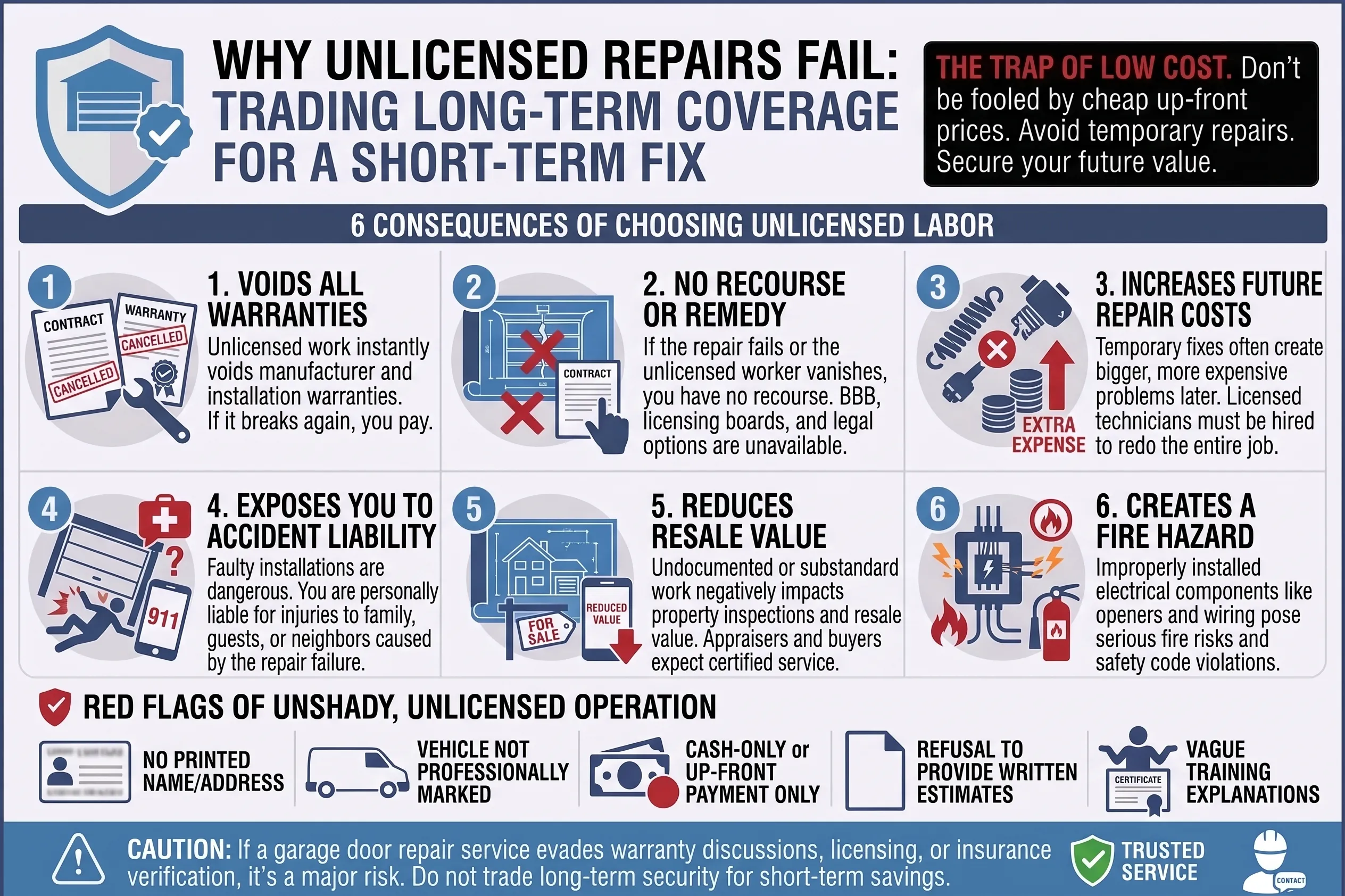
A single unlicensed repair can void coverage on the door, the opener, and any related part connected to the work performed, even when the repair itself appears to function correctly. What looks like a quick, affordable fix often removes protection that would otherwise apply for years.
Brothers Garage Door Service performs licensed, warranty-eligible repairs for residents across Livonia who want coverage that actually holds up if an issue comes up later. Contact us or give us a call today, and let our licensed technicians complete the job in a way that keeps every warranty intact.