
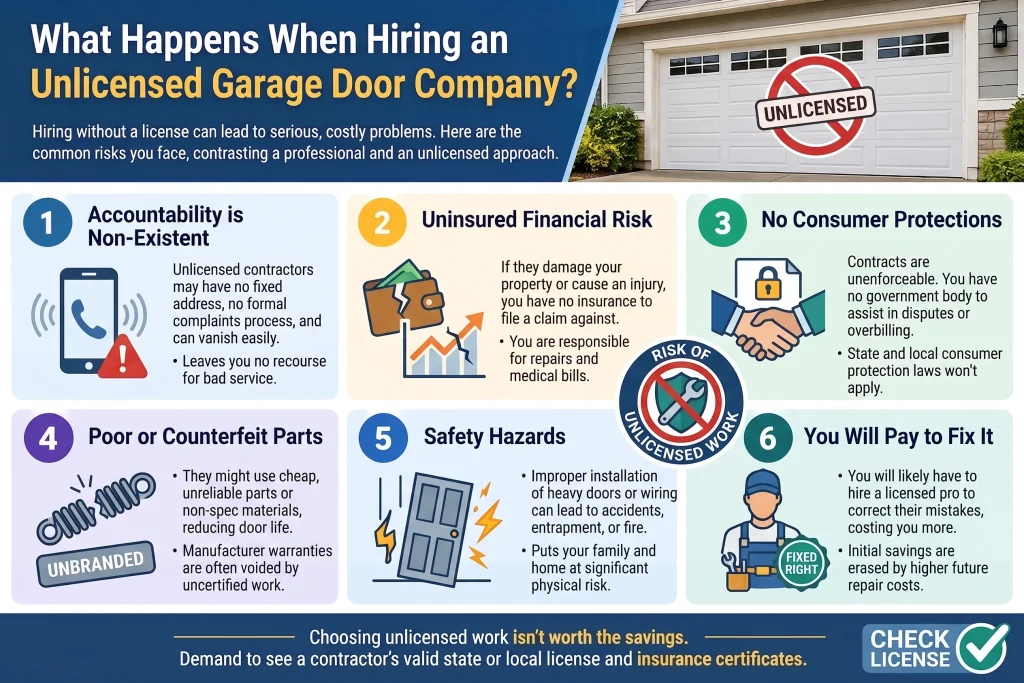
An unlicensed garage door company puts property, money, and safety at risk through uncertified work that voids warranties and removes any legal path to recovery. A missing license often means missing insurance too, leaving the property owner to cover the full cost of injury or damage from garage door repair work.
Livonia residents searching for fast or affordable service sometimes skip licensing checks, assuming a business appearing in local search results has already been vetted. The sections below explain what separates a licensed operator from an unlicensed one and what tends to go wrong when you hire the wrong company.
Key Takeaways
- Unlicensed companies often use fake or expired credentials to appear legitimate.
- Warranties on doors and openers are voided by uncertified installation work.
- Property damage or injury from an unlicensed technician usually falls on the property owner.
- Confirming a license number takes minutes and prevents most licensing-related losses.
- Reporting an unlicensed company helps protect other residents in the area.
How Unlicensed Garage Door Companies Get Hired
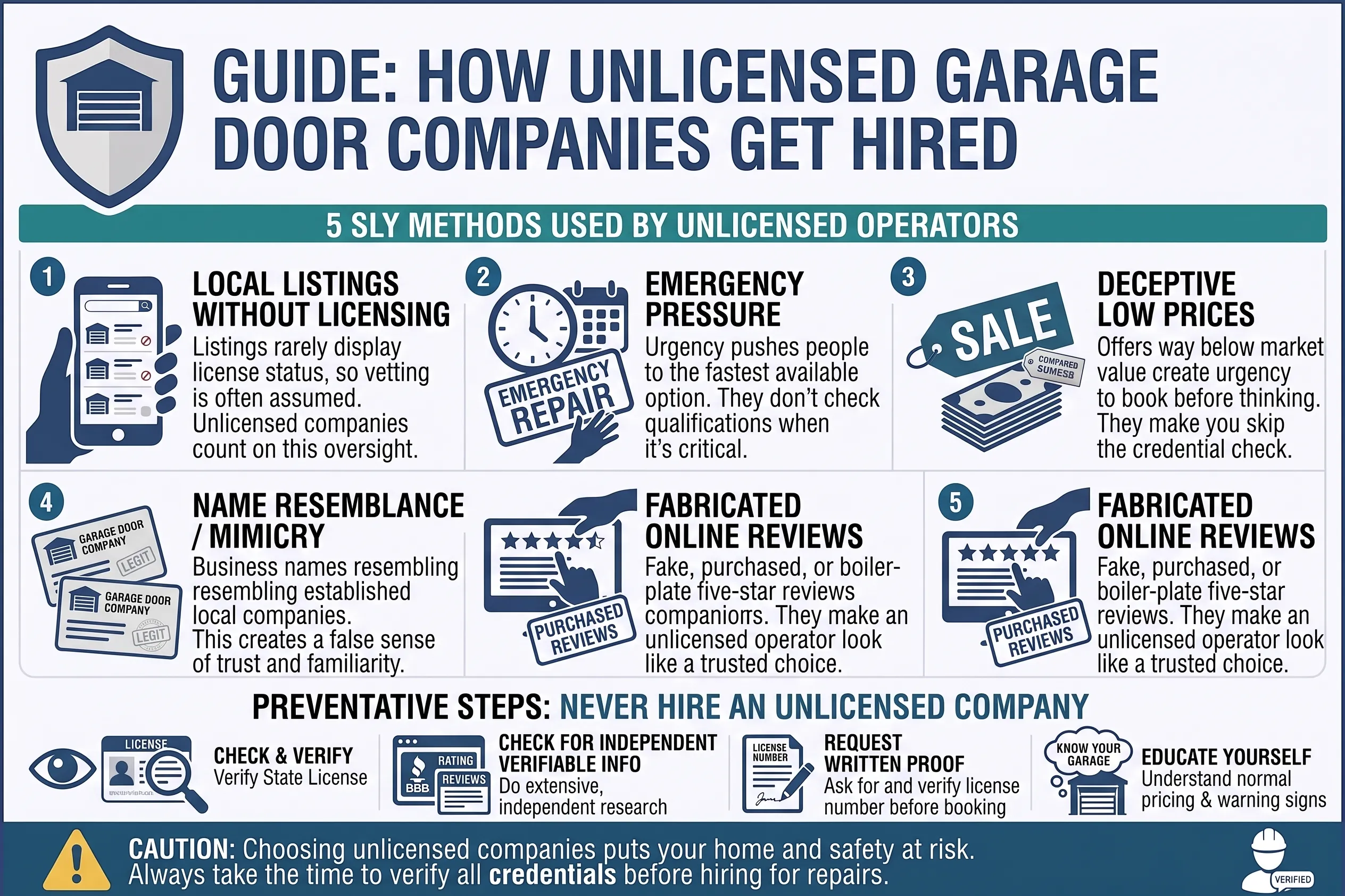
Unlicensed operators rely on speed, low pricing, and confident presentation to get through the door before anyone asks the right questions about credentials.
A few patterns explain why unlicensed hires happen so often:
- Local listings rarely display license status, so vetting is often assumed.
- Emergency repairs push people toward the fastest option, not the most qualified one.
- Prices well below competitors create urgency to book before comparing credentials.
- Business names resembling established local companies create false trust.
- Purchased or fabricated reviews make an unlicensed company look established.
To understand the documentation unlicensed operators use to appear credible, read our guide on What Fake Credentials Do Unlicensed Garage Door Companies Use?, which breaks down the fake licenses and certificates scammers present.
Warning Signs a Garage Door Company Is Not Licensed
A cluster of distinct patterns tends to surface before, during, or immediately after a repair when the company doing the work isn’t properly licensed.
The following signs point directly to a licensing problem:
- Technicians arrive in unmarked vehicles without a company name, logo, or state registration number.
- The business has no local physical address and no legitimate showroom to visit.
- Quoted prices increase sharply once the technician is already on site.
- Written estimates and invoices are never provided, only verbal totals.
- Payment is requested in cash only, with no card or check option.
If two or more of these signs appear during a single visit, stop the job and do not pay the company until you confirm credentials.
How to Confirm Licensing Before Work Begins
Confirming a license takes only a few minutes and prevents most of the financial and safety risks tied to hiring an unlicensed garage door company.
A quick verification process covers the following steps:
- Ask for the full legal name, license number, and proof of insurance before scheduling.
- Search the Michigan Department of Licensing and Regulatory Affairs database directly.
- Confirm the license covers the specific service being requested.
- Call the number listed for the business and compare it against the scheduling number.
- Request a written estimate before work starts.
To walk through the verification steps, including which databases to check and how to confirm insurance, read our guide on How to Verify a Garage Door Company Is Licensed, which breaks down exactly how to look up a valid license before booking.
What Goes Wrong When the Company Is Not Licensed?
Once an unlicensed company begins work, the risks extend into financial, safety, and legal territory that most people never anticipate before the job starts.
Specific Risk | What It Means for the Property Owner | Why It Happens |
Financial | ||
No Insurance Protection | Medical bills or damage costs fall on the property owner | No liability coverage backs an unlicensed technician |
Hidden Costs | A low quote grows into a much larger final bill | Extra charges get added once the job is already underway |
No Way to Recover Lost Money | No bond or state fund exists to reclaim losses | Unlicensed work carries no financial backing or accountability |
Safety and Quality | ||
Faulty Repairs | High-tension parts fail suddenly without warning | Installation skips safety standards for springs and cables |
Non-Compliant Work | Code violations surface during sales or inspections | No permits or inspections are completed during the job |
Voided Warranties | Manufacturer coverage on the door and opener is lost | Uncertified parts and methods fail warranty requirements |
Legal and Property | ||
Fines and Penalties | Property owners face fines for unpermitted work | Local and state codes hold owners responsible, not just contractors |
Scams and Theft | Garage access exposes tools, codes, and entry points | Unverified technicians are not subject to background checks |
No Recourse | No formal complaint or refund path exists | No licensing board oversees unlicensed businesses |
Verifying a garage door company license and insurance before hiring prevents most of these outcomes and protects both the door and the property owner.
Financial Risks
No Insurance Protection
An unlicensed technician working without insurance leaves the property owner responsible for any injury or damage that happens during the job.
This coverage gap shows up in a few predictable ways:
- Medical bills from a technician injury may fall on the property owner’s insurance.
- Damage to the garage, driveway, or garage door cables may not be covered by any policy.
- No general liability coverage exists to file a claim against if something breaks.
- Vehicle or property damage during parts transport is rarely reimbursed.
- Legal fees from a resulting dispute are paid entirely out of pocket.
Property owners left without insurance backing after an uninsured repair absorb every dollar of the resulting damage themselves.
Hidden Costs
Unlicensed companies often quote an artificially low price to secure the job, then add charges once the technician has already started work.
These added charges tend to follow a consistent pattern:
- A low base quote is followed by charges for parts labeled as unexpected.
- Labor fees increase once the job is already underway.
- Disposal fees for old parts appear without being mentioned upfront.
- Emergency or after-hours surcharges get added even for daytime appointments.
- Return trip fees are charged for issues that should have been resolved the first visit.
A quote priced well below competitors is often the first sign of hidden costs still to come, especially once the job is already underway.
No Way to Recover Lost Money
Licensed contractors are typically backed by a state recovery fund or surety bond that helps reclaim losses from fraudulent or incomplete work.
Limited options remain once that backing does not exist:
- Small claims court becomes the only realistic path, with no guarantee of collection.
- Credit card disputes may fail if you paid in cash as requested.
- The business often disappears or rebrands under a new name shortly after.
- No licensing board exists to hold the individual or company accountable.
- Legal fees to pursue a claim frequently exceed the amount originally lost.
Cash-only payment requests often signal a deliberate effort by the company to remove any real path to recovering lost funds later.
Safety and Quality Risks
Faulty Repairs
Garage doors rely on high-tension springs and cables strong enough to lift hundreds of pounds, so improper installation can cause sudden failure.
Installation errors of this kind typically create the following hazards:
- Springs wound to the wrong tension can snap without warning.
- Cables installed improperly may fray and fail under normal daily use.
- Doors left out of balance place strain on the opener and its motor.
- Sensors installed incorrectly may fail to stop the door when they detect an obstruction.
- Tracks misaligned during installation cause the door to bind or jump.
A door that feels heavier, louder, or slower right after a repair often points directly back to faulty, uncertified installation work.
Non-Compliant Work
Unlicensed technicians often skip building codes and manufacturer standards, since no inspection process holds them accountable.
Non-compliant installations tend to surface through these issues:
- Permits required for structural or electrical work are never pulled.
- Fire-rated door requirements between garage and living space go ignored.
- Electrical wiring for openers is completed without following local code.
- Ventilation and clearance requirements around the door are overlooked entirely.
- Documentation needed for future home inspections or sales is never provided.
Missing permit records tend to surface at the worst possible time, usually during a home sale or an unrelated insurance claim.
Voided Warranties
Manufacturer warranties require certified installation and approved parts, and unlicensed work almost always fails to meet those conditions.
Warranty coverage is typically lost under these conditions:
- Springs, cables, or openers are replaced with uncertified aftermarket parts.
- Installation steps skip the sequence the manufacturer requires.
- No proof of licensed installation exists to support a claim.
- Modifications are made to factory settings without approval.
- Required registration or documentation is never filed after installation.
To confirm which protections disappear once uncertified work has been performed, read our guide on What Warranty Protection Is Lost With an Unlicensed Repair?, which breaks down manufacturer terms and voiding triggers tied to unlicensed installation.
Legal and Property Risks
Fines and Penalties
Many states and municipalities penalize property owners, not just contractors, for knowingly hiring unlicensed labor for regulated home repairs.
Penalties in this category typically include the following:
- Local code enforcement can issue fines for unpermitted structural work.
- State licensing violations may carry separate penalties for the unlicensed business.
- Insurance claims tied to unpermitted work are frequently denied outright.
- Home sales can be delayed when unpermitted work surfaces during inspection.
- Repeat violations increase fine amounts and legal exposure over time.
Unpermitted garage door work can trigger fines and legal exposure long after the original job is finished and forgotten.
Scams and Theft
Letting an unverified individual into the garage unsupervised risks exposing tools, vehicles, and entry points into the home.
Specific vulnerabilities appear once that access is granted:
- Garage door codes and remotes may be copied or photographed during the visit.
- Valuable tools or equipment stored in the garage become visible and accessible.
- A second, unscheduled visit may be scheduled without being requested.
- Personal information shared during payment can be used for later contact attempts.
- Entry points into the home through the garage remain exposed during the visit.
Feeling pressured to leave an unverified technician unsupervised in the garage is reason enough to end the visit immediately.
No Recourse
Poor quality work from a licensed contractor gives property owners a way to file a formal complaint with the state licensing board and pursue a fix, refund, or investigation.
The following dead ends appear instead once that licensing gap exists:
- No licensing board exists to receive a formal complaint against the business.
- State consumer protection funds only apply to licensed and bonded contractors.
- Online reviews become the only available way to warn other residents.
- Legal action requires you to identify and locate the business on your own.
- No professional association holds the technician accountable for the finished work.
Unlicensed operators exist entirely outside the accountability system that protects property owners after licensed work goes wrong.
What to Do If You Already Hired an Unlicensed Company
Discovering after the fact that an unlicensed company completed a repair does not eliminate every option for correcting the situation.
A prompt response should include the following steps:
- Stop further payment and additional visits with the same company.
- Have a licensed technician inspect the work before using the door again.
- Document the work with photos, invoices, and written communication.
- Dispute the charge through the bank or card issuer if paid in cash.
- Request garage door maintenance from a licensed provider to correct code violations.
Quick action after discovering an unlicensed repair limits further safety risk, financial loss, and the chance of repeat damage.
How to Report an Unlicensed Garage Door Company
Reporting an unlicensed operator protects other residents from the same experience and creates an official record that can support legal or financial recovery efforts.
A report typically moves through one of these channels:
- File a complaint directly with the Michigan Department of Licensing and Regulatory Affairs.
- Submit a report through the local Better Business Bureau to warn other consumers.
- Report the business to local police if theft or property damage occurred.
- Leave a detailed, factual review describing the licensing issue for others.
- Contact garage door installation professionals to confirm what proper documentation should have looked like.
A single report helps build a documented, verifiable pattern that protects future residents from the same unlicensed operator.
Hiring an Unlicensed Garage Door Company Ends in Preventable Losses
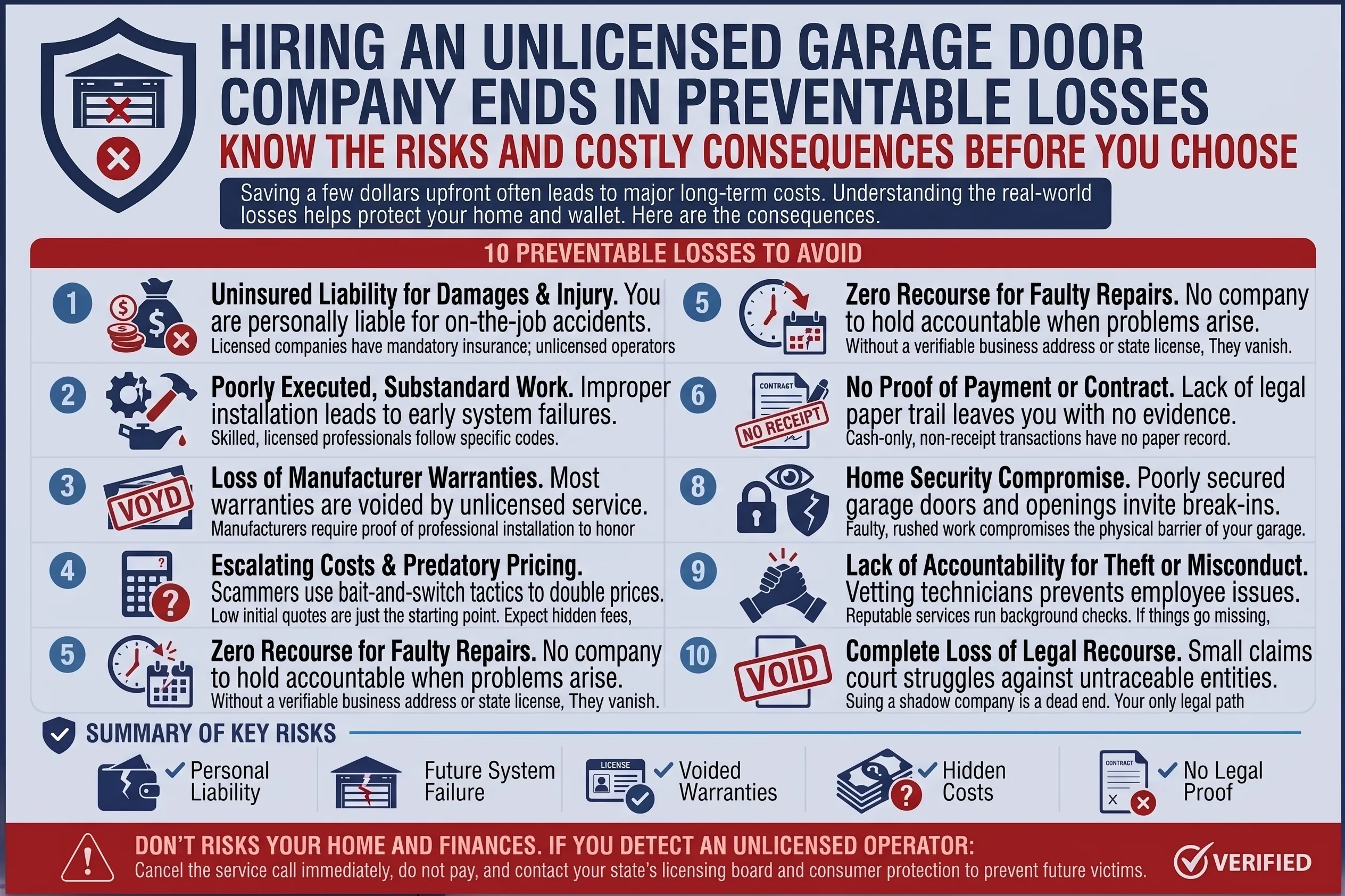
A single decision to bypass a license check can turn a routine garage door repair into a financial, safety, and legal problem all at once. What begins as an effort to save time or money on a quick fix often ends up costing far more once damage, voided warranties, or an unrecoverable payment enter the picture.
Brothers Garage Door Service completes licensed, warranty-eligible garage door replacement work for Livonia residents who want the job done right the first time. Contact us or give us a call today, and let our licensed technicians confirm the credentials that matter before any work begins.