
Unlicensed garage door companies rely on fabricated licenses, fake insurance certificates, and stolen branding to appear legitimate before any work begins. These fake credentials are designed to survive a quick glance, not close inspection, which is exactly why so many property owners get fooled during a garage door repair call.
A property owner who knows what these fabricated documents and specific details actually look like can spot the problem before a technician ever steps into the garage. The sections below break down the specific credentials scammers fake most often and exactly how each one is meant to deceive.
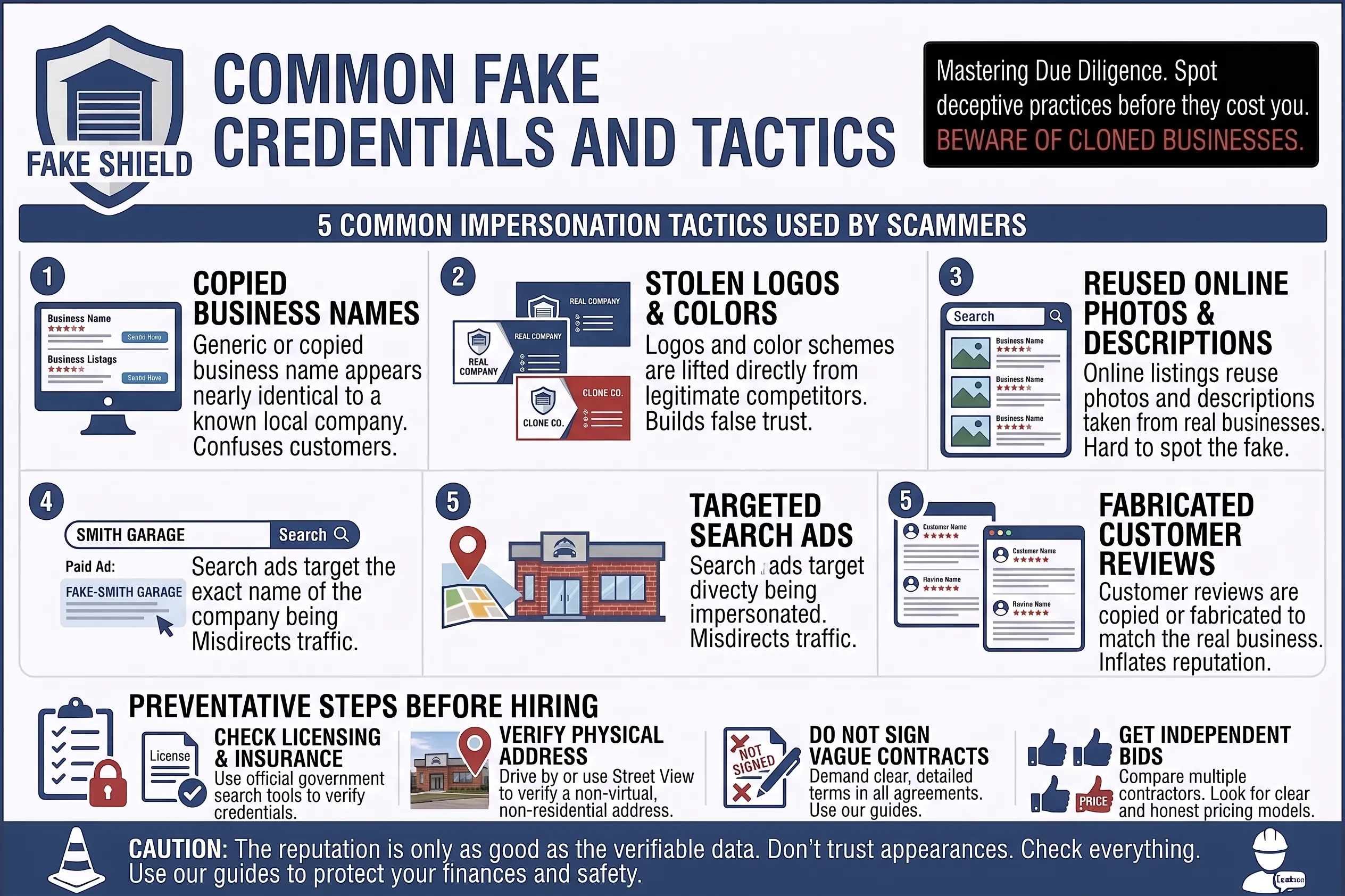
Scammers frequently steal the exact name, logo, and branding details of a real, established garage door company to trick both search engines and customers.
This tactic tends to follow a consistent pattern:
To understand what happens once one of these impersonated companies gets hired, read our guide on What Happens When Hiring an Unlicensed Garage Door Company?, which breaks down the financial, safety, and legal risks that follow.
A phony street address, virtual office, or P.O. box is often listed to create the appearance of a nearby, established business operating out of the area.
These fake addresses tend to share a few common traits:
Shifting or unverifiable addresses across multiple online listings are often the fastest, most reliable way to confirm a business is not truly local.
A company may claim to be licensed and insured over the phone or in a paid search ad, yet fail to produce a real, verifiable license number once asked directly.
This gap between the claim and the paperwork tends to show up clearly:
To confirm whether a license number is real before any repair begins, read our guide on How to Verify a Garage Door Company Is Licensed, which covers the exact steps for checking a license against the state database.
Insurance certificates presented on site are sometimes copied, altered, or invented entirely, leaving the property owner with no real liability protection during the job.
These fabricated documents tend to reveal themselves through the following signs:
To find out which protections are lost once fake insurance paperwork is involved, read our guide on What Warranty Protection Is Lost With an Unlicensed Repair?, which breaks down how missing coverage affects manufacturer warranty terms.
Printed identification badges are sometimes produced specifically to mimic the appearance of a legitimate company employee credential.
A few details tend to expose these fabricated badges:
Businesses using fabricated identification can be reported directly to help prevent the same tactic from working on another property owner.
Knowing exactly where to look and what to check turns a vague feeling of doubt into a confirmed answer within minutes.
|
Credential Type |
How to Verify a Real One |
Common Sign of a Fake One |
|
License Number |
Search the Michigan LARA database directly |
Number does not match any record on file |
|
Insurance Certificate |
Call the listed insurer to confirm active coverage |
Coverage dates are expired or cannot be confirmed |
|
Business Address |
Confirm a physical location through mapping tools |
Address is a P.O. box or virtual office |
|
Employee ID |
Ask the company office to confirm the employee number |
No employee record exists for the name shown |
|
Branding |
Compare the business name against state registration |
Name closely mimics a known local company |
Verifying even one of these details directly with the source, rather than trusting what is shown on site, exposes most fabricated credentials immediately.

A company relying on stolen branding, fake addresses, or fabricated licenses depends entirely on property owners not asking the right questions before hiring. Any fake license, certificate, or badge can be confirmed or disproven within minutes using a state database, a phone call, or a direct request for documentation.
Brothers Garage Door Service provides licensed, verifiable credentials on every job completed for residents across Livonia who want proof before any technician starts work. Contact us or give us a call today, and let our licensed team show the documentation that unlicensed companies cannot produce.